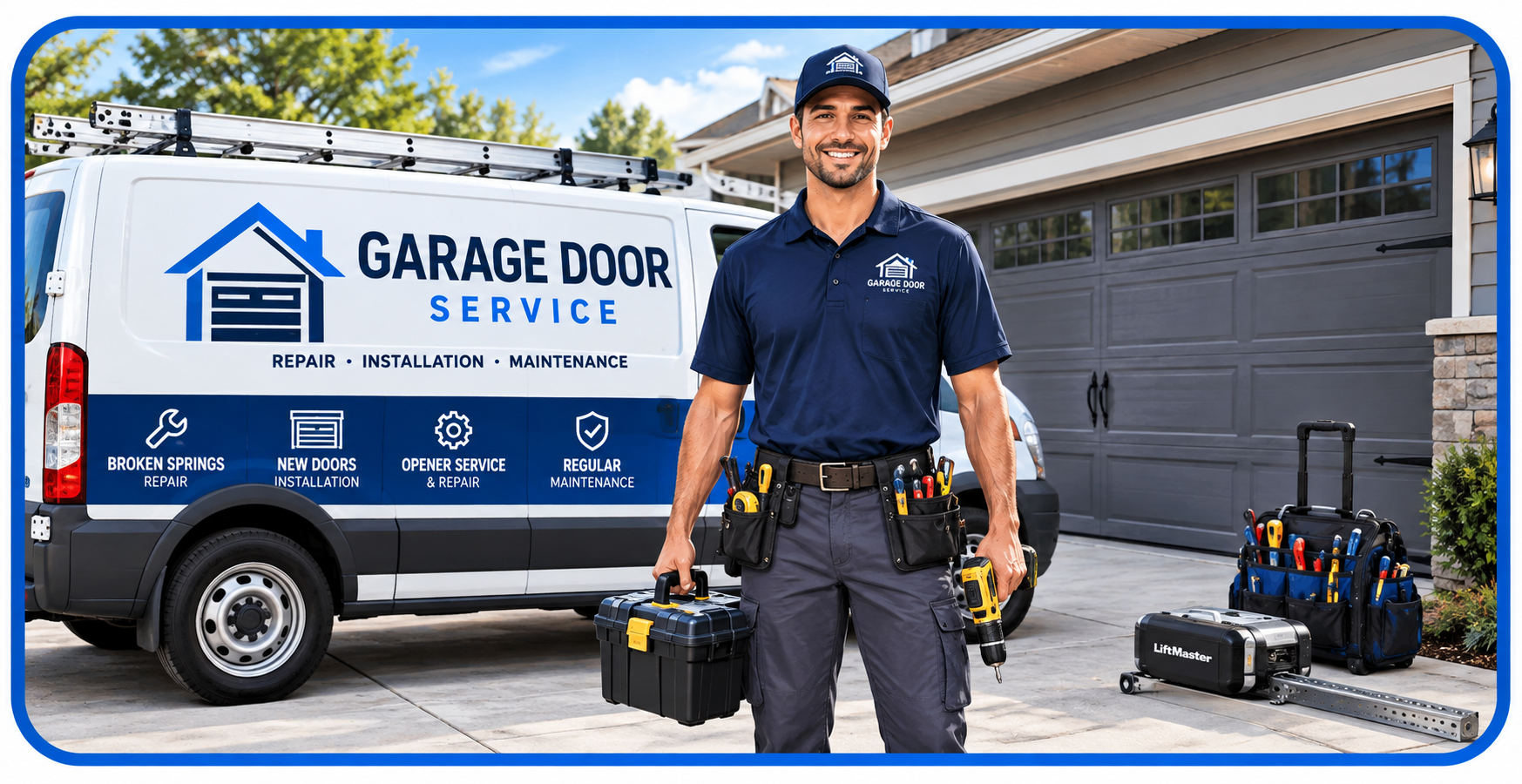
Modern openers are complex circuit-board systems with motor drives, wireless receivers, and safety logic. Kelly Garage Door Services carries brand-specific diagnostic tools to find the real fault, not just guess and swap parts.
Today's garage door openers are not simple motors. They include logic boards, wireless coding systems, force-sensing circuits, and safety interlock systems that require tools and training to properly diagnose.
Every opener technician we dispatch holds current state licensing and full liability coverage. You get professional accountability with every service call, regardless of whether the job ends in a repair or a replacement recommendation.
Based in and around Garage Door Opener Repair, our team doesn't travel from a distant regional hub. When your opener fails, we can typically dispatch the same day. Local proximity means faster response when your schedule depends on a working door.
After diagnosing your opener, we provide a written flat-rate quote before any repair begins. You'll know exactly what the service costs before you agree to anything. There are no added fees after the work is done.
We carry diagnostic tools configured for the major opener brands, including LED indicator readers, frequency testers, circuit board testing equipment, and motor load analyzers. The right tools make the difference between a fast correct diagnosis and costly part swapping.
From simple sensor misalignments to full logic board failures, Kelly Garage Door Services handles the complete range of garage door opener repair scenarios in Garage Door Opener Repair and County.
The logic board is the brain of a modern garage door opener. It processes signals from wall buttons, remotes, and keypads, controls motor direction and speed, manages safety sensor inputs, and stores the wireless codes that pair remotes and phone apps. When a logic board fails due to a power surge, a lightning proximity event, moisture intrusion, or simple component aging, the opener may become completely unresponsive, respond erratically, or show a specific blink code that indicates the fault type. Our technicians carry diagnostic reference guides for the major opener brands and use electrical testing equipment to assess whether the board has failed or whether a secondary component such as a capacitor or relay is responsible. When the board is the confirmed failure point, we can often source replacement boards for popular models and install them on the same service visit. For older units where the board is discontinued, we evaluate the cost-versus-value comparison between board sourcing and full unit replacement honestly and without pressure.
The drive mechanism inside a garage door opener, whether a chain drive, belt drive, screw drive, or direct drive, transfers the motor's rotational force into the linear movement that pulls the trolley and moves the door. The most common wear point in chain and belt drive systems is the drive gear set, typically a nylon gear that meshes with a metal worm gear on the motor shaft. This nylon gear is designed as the sacrificial failure point in the system, protecting the more expensive motor from damage when the door encounters resistance. A stripped drive gear produces a distinctive chattering or grinding sound when the opener runs but fails to move the door. Kelly Garage Door Services technicians carry replacement gear kits for the most common opener brands and can typically complete a drive gear replacement in under two hours. We also lubricate the entire drive system and check the rail alignment and trolley condition during the repair visit, since a stripped gear can indicate that the door was running with excessive resistance before the failure.
Photo-electric safety sensors are the pair of small devices mounted near the floor on either side of the door opening. They project an infrared beam across the opening, and if that beam is interrupted while the door is closing, the opener automatically reverses. They are required by federal safety standards on all openers manufactured after 1993, and a misaligned, dirty, or damaged sensor can cause a door that will not close at all, or one that closes and immediately reverses without any visible obstruction. Sensor issues are frequently misdiagnosed as opener failures. Our technicians check sensor alignment, clean the lens faces, test the beam continuity, and verify that the mounting brackets are secure and undamaged. If a sensor has failed internally rather than just misaligned, replacement is a straightforward repair. We also adjust the sensor mounting height and cable routing to minimize the likelihood of accidental future misalignment from vibration or impact.
Remotes and keypads that stop responding to the opener are one of the most frustrating low-urgency opener issues. The cause can be as simple as a dead battery or as involved as a receiver board that has lost its stored codes after a power interruption. Our technicians are equipped to re-program remotes and keypads for all major opener brands, including multi-button remotes, HomeLink vehicle integrations, and exterior keypad units. We also address situations where an opener has been programmed to refuse new remote codes due to a locked security setting, and where a wireless frequency interference source in the neighborhood is preventing reliable communication between the remote and receiver. In cases where the wireless receiver circuit inside the older opener has failed, we can install an external universal receiver that supports current remote protocols, extending the functional life of an otherwise working opener unit without requiring a full replacement.
The motor is the most durable component in a typical garage door opener, often lasting well beyond the service life of the drive mechanism and electronics. When a motor does fail, the signs include a unit that hums without moving, runs hotter than usual, or trips its thermal protection switch repeatedly during normal operation. A failed start capacitor is a common cause of a motor that hums but doesn't turn, since the capacitor provides the initial torque kick needed to start motor rotation from a standstill. Capacitor failure is significantly less expensive to repair than full motor replacement, and our technicians test the capacitor before recommending a motor replacement. If the motor itself is the confirmed failure, we assess whether a replacement motor is available for the unit and cost-effective relative to a new opener installation. For openers that are otherwise functional and relatively current, motor replacement often makes more economic sense than a full unit swap, especially if the drive rail, trolley, and bracket hardware are all in good condition.
Garage door opener force and limit settings are the calibration parameters that tell the unit how far to travel in both directions and how much resistance to tolerate before triggering an automatic reversal. These settings need to be calibrated to the specific door they are operating, and they can drift out of specification over time, particularly after a spring replacement, cable repair, or any change that alters the door's operational weight or resistance profile. A door with incorrect force settings may not fully close, may not fully open, may apply excessive down-force when closing, or may fail the auto-reverse safety test. Incorrect force settings can also cause the opener to strain unnecessarily, accelerating motor wear. During every opener service call, Kelly Garage Door Services technicians verify both force and limit settings and adjust them as needed to match the door's current operational characteristics. We perform the auto-reverse test as a standard safety verification step on every visit, not as an optional add-on.
Call +1-866-597-3069 and tell us what the opener is doing or not doing. Our dispatcher asks targeted questions to prepare the technician before they arrive.
The technician arrives at your Garage Door Opener Repair location with diagnostic tools for your opener brand and conducts a systematic fault isolation process.
We identify the specific failure point, explain it clearly, and provide a flat-rate repair quote. Repair vs. replacement is addressed honestly with cost comparison.
We complete the repair, configure all remotes and keypads, set force and limit parameters, and run full safety tests before considering the job done.
"My opener would run but not move the door. A different company told me I needed a new opener. Kelly Garage Door Services came out and found a stripped gear set that cost a fraction of a full unit replacement. Fixed in 90 minutes and the opener runs great. Very glad I got a second opinion."
"Opener stopped responding to every remote and keypad after a power outage. Kelly Garage Door Services figured out the receiver circuit had been fried by the surge and installed an external receiver unit that supported all our existing remotes. No new hardware needed. Brilliant solution."
"Our door kept closing and bouncing back up. Three calls to the opener manufacturer's support line got me nowhere useful. Kelly Garage Door Services arrived, found both sensors were slightly out of alignment after a minor bump to the mounting bracket, adjusted them, and the door has worked perfectly ever since."
Kelly Garage Door Services services garage door openers throughout Garage Door Opener Repair, County, and surrounding communities. Brand-specific diagnostics, same-day service, flat-rate pricing.
📞 Call +1-866-597-3069 for Opener Diagnosis